
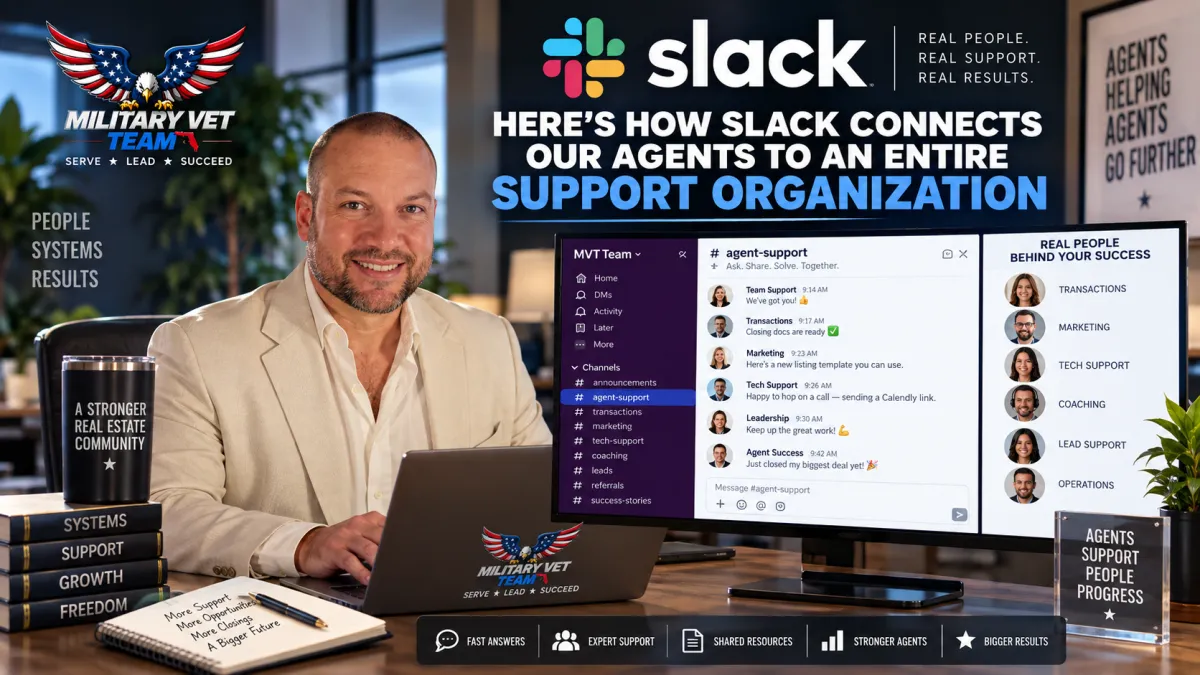
Here’s How Slack Connects Our Agents to an Entire Support Organization
An agent can know exactly how to write an offer and still get stuck at 4:45 on a Friday afternoon.
Maybe there's a contract question.
Maybe the listing needs to go live.
Maybe something changed with a transaction and the agent needs another set of eyes on it.
That moment is where I think a lot of real estate organizations expose the difference between offering training and actually supporting agents.
I train Realtors live every morning from 9 to 11. I believe heavily in training. I've personally listed and sold more than 100 homes, and I've managed and mentored hundreds of transactions since 2017. I know how much good education can shorten an agent's learning curve.
But training can't answer every question an agent will face at 4:45 Friday.
That's why the system around the agent matters.
At the Military Vet Team at LPT Realty, one of the tools that helps create that connection is Slack. It gives agents a place to reach leadership, mentors, transaction support, listing support, marketing and other parts of the organization without trying to figure out who they need to chase down.
That matters because real estate isn't an individual sport nearly as often as people think.
Why Isn't Training Alone Enough for a Real Estate Agent?
Training gives agents knowledge, but support helps them apply that knowledge when a real transaction gets complicated. Agents need both if they're going to consistently serve clients well.
I've watched agents take great notes during morning training.
Then something happens at 2 PM that wasn't in the notes.
That's real estate.
A buyer wants to change terms. An inspection finds something unexpected. A seller calls worried about activity on the listing. A military family gets an update to their PCS timeline. A transaction coordinator needs paperwork. Marketing needs property information before creating listing materials.
The agent has to respond.
Earlier this year, I had an agent reach out because something in a transaction wasn't matching what they expected from training. They didn't need another two-hour class. They needed somebody experienced to look at the actual situation with them.
That's an important distinction.
Training prepares you for patterns.
Support helps you handle reality.
As Director of Mentorship and Senior Director of Recruitment, I don't want agents feeling like they're alone once training ends. The whole point of building a support organization is giving them somewhere to go when the textbook version and the real-world version stop matching.
How Does Slack Help Agents Get Answers Faster?
Slack can help agents get answers faster by organizing communication into dedicated channels where the right people can see the question, understand the context, and respond. Instead of every issue disappearing into private texts and emails, communication can be routed to the people responsible for that part of the business.
Slack itself recommends organizing channels around teams, projects, and functions because channels create visibility around responsibilities and keep information searchable for others who may need it later.
That's exactly why the channel concept makes sense to me in real estate.
Imagine you're an agent and you need help with a listing.
You shouldn't have to text five people asking, "Who handles this?"
You should know where listing questions belong.
If you need transaction support, there should be a clear place for that.
If you need mentorship, leadership, marketing assistance, onboarding help, or another operational resource, you should know where to start.
That's a small thing until you're running appointments all day.
Then it's huge.
I serve clients throughout Pinellas and Hillsborough Counties. On a normal day I might be talking with someone near MacDill AFB, dealing with a property in St. Petersburg, answering an agent question, and then heading toward Clearwater or Dunedin.
I'm not sitting at a desk waiting for the next email.
Neither are our agents.
A communication system has to match how Realtors actually work.
What Happens When Leadership and Mentors Are Accessible?
Accessible leadership helps agents make better decisions because they can ask questions before small problems become bigger ones. It also creates accountability because agents aren't operating inside their own little bubble.
This is something I care about deeply.
There's a big difference between saying, "My door is always open," and actually building a system where people know how to reach you.
An agent might need coaching on a conversation with a seller.
Another might need help thinking through a VA buyer's situation.
Someone else may be struggling with lead follow-up and needs a mentor to ask the uncomfortable question:
"How many people did you actually call?"
Those are different needs.
They shouldn't all go to the same person.
That's the benefit of an organization with defined support roles.
Leadership can lead.
Mentors can mentor.
Operations can handle operational issues.
And the agent can stay focused on clients and production.
In my morning training recently, an agent brought up a lead that had gone quiet. We worked through the follow-up approach together. Later, the agent could continue the conversation with support rather than waiting until the next morning's class.
That's what I want.
Training shouldn't be an isolated event.
It should connect directly to what happens during the rest of the workday.
Why Do Transaction Coordinators Matter So Much?
Transaction coordinators matter because once a contract is executed, there are deadlines, documents, communication points, and moving pieces that need consistent attention. Good transaction support allows the agent to stay involved with the client without trying to carry every administrative detail alone.
People outside real estate don't always see how many hands can touch one closing.
There's the buyer.
Seller.
Agents.
Lender.
Title company.
Inspector.
Insurance.
Appraiser.
Then you add contract deadlines, amendments, documentation, repair negotiations, financing milestones, and closing coordination.
That's a lot of moving pieces.
For a PCS family coming into MacDill, there may be another layer. Report dates. Travel. Temporary lodging. Household goods. A spouse trying to coordinate work and schools.
The agent needs to stay present.
A transaction coordinator isn't there to replace the agent's responsibility. The agent still owns the relationship.
Support gives that agent another layer of organization.
Current industry technology conversations are moving in this same direction. NAR recently highlighted the value of connected systems in real estate, noting that properly integrated tools can increase clarity and help transactions move faster.
That's the goal.
Not more technology for the sake of technology.
Better communication around the transaction.
How Does Listing and Marketing Support Help an Agent Produce More?
Listing and marketing support can remove administrative friction so agents spend more time prospecting, meeting clients, negotiating, and following up. The agent still has to create the opportunity, but the organization can help execute the work surrounding it.
I've seen agents lose half a day trying to solve something that should take 15 minutes.
A listing goes live and they need marketing materials.
They need an open house promoted.
They need information corrected.
They need help getting a property in front of the right audience.
Meanwhile, the agent has three leads sitting in the CRM without a follow-up call.
That's where I start asking questions.
What actually requires the agent?
Nobody can build your relationships for you.
Nobody can replace your listing appointment.
Nobody should negotiate for your client without the proper role and responsibility.
But does the agent personally need to spend two hours figuring out every administrative process?
Probably not.
A support organization should help agents protect the activities that produce business.
I've watched this firsthand with listings throughout Tampa Bay. If an agent has a new property in Clearwater, St. Pete, Dunedin, or South Tampa, speed matters. The information needs to move from the agent to the appropriate support people accurately.
Dedicated communication channels help make that handoff visible.
The request isn't buried in someone's text messages.
The team can see what needs to happen.
Does Slack Create Accountability or Just More Messages?
Slack can create accountability when channels have clear purposes, responsibilities, and expectations. Without structure, it's just another inbox.
That's the part people miss.
Adding technology doesn't automatically fix an organization.
You have to define how people use it.
Slack's own 2026 guidance on workplace accountability emphasizes shared visibility, clear expectations, and written communication. Shared channels can make commitments visible without requiring managers to constantly chase people for updates.
That's exactly how I think about it.
If an agent asks for something, who owns the next step?
If support needs information from the agent, did the agent provide it?
If a transaction has an issue, has it been communicated?
Visibility creates accountability on both sides.
This isn't about watching people.
It's about eliminating the sentence, "I thought somebody else was handling that."
I've been in this business long enough to know how expensive that sentence can become.
Why Does This Matter for Agent Recruitment and Retention?
Support matters because agents aren't just choosing a brokerage based on a logo or commission structure. They're also choosing the environment in which they're expected to build a business.
NAR's 2026 to 2028 strategic plan reflects that broader industry shift. It calls for tools, training, support, stronger broker engagement, transparent information flow, and better communication pathways that help Realtors succeed in their daily businesses.
That resonates with me because I recruit agents.
When I talk to an agent considering a move, I don't want the conversation to stop at, "Here's our technology."
Technology isn't mentorship.
Technology isn't leadership.
Technology isn't accountability.
The question is what the technology connects you to.
Can you reach somebody when you're stuck?
Do you know where to go for transaction questions?
Is there listing support?
Is there marketing support?
Can you reach leadership?
Are there mentors who have actually done the business?
That's the difference.
A Slack channel itself isn't the value.
The people on the other side of it are.
Quick Questions Agents Ask Me About Support Systems
Does Slack replace real mentorship?
No. Slack is a communication tool, not a mentor. Its value is that it can make experienced people and departments easier to reach when an agent needs support.
Should every question go into a public channel?
No. Some conversations involve clients, confidential information, compliance concerns, or personal coaching and need the appropriate private setting. The goal is organized communication, not putting everything in public.
Can support systems make a struggling agent productive?
They can help, but they can't replace action. An agent still has to prospect, follow up, practice, meet clients, and do the work. Support removes friction. It doesn't remove responsibility.
What Does a Real Support Organization Look Like to Me?
A real support organization means an agent knows they're responsible for their business, but they also know they don't have to solve every problem alone.
That's the balance.
I can train you from 9 to 11.
A mentor can help you work through a difficult conversation.
Leadership can give direction.
Transaction support can help keep a closing organized.
Listing and marketing support can help move property information and materials where they need to go.
Operations can solve problems that shouldn't consume an agent's entire afternoon.
Slack can help connect those pieces.
That's what interests me.
Not another app.
Connection.
The real estate industry keeps adding technology. NAR's 2026 technology work is increasingly focused on reducing fragmentation and operational clutter, while Slack's current product direction is centered on bringing people, tools, and organizational context into shared workspaces.
But I'll keep coming back to the same principle I teach agents every morning.
Tools don't produce.
People do.
Systems simply help good people work together more effectively.
If you're an agent who feels like you're constantly hunting for answers, handling every administrative issue yourself, or trying to build a business without real support around you, reach out to me. I'll show you how we think about training, accountability, mentorship, and support at the Military Vet Team, and you can decide if that kind of environment fits the business you're trying to build.