
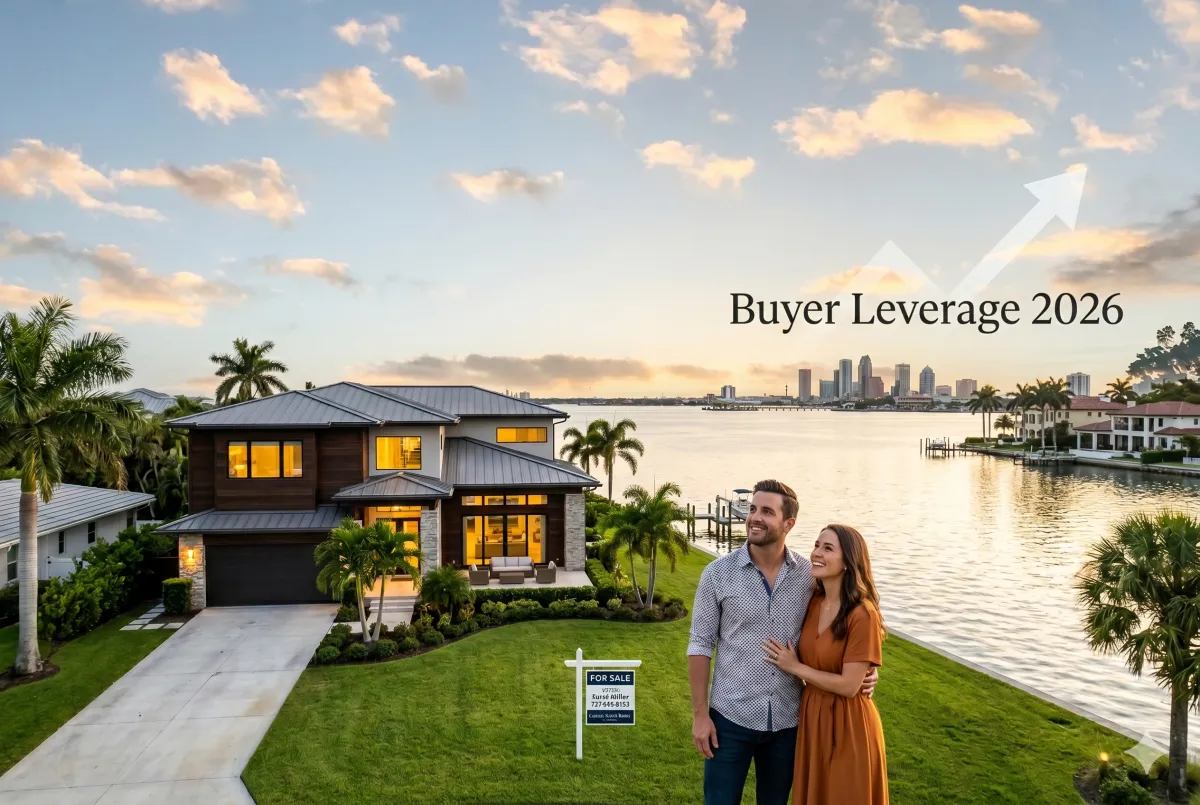
Is 2026 a Good Time to Buy in Tampa Bay? What the Latest Pinellas and Hillsborough Data Shows
Every morning, I sit down with fresh MLS data from Pinellas and Hillsborough counties. The story those numbers tell in June 2026 isn't about a market collapse, no matter what the doom-and-gloom news cycle suggests. It's about a long-overdue rebalancing after the chaotic boom years, when buyers were forced to skip inspections, write love letters, and pay tens of thousands over asking just to compete.That pressure cooker has finally released steam.
Right now, roughly 48% of active listings across the Tampa area have trimmed their asking prices. Single-family homes are taking between 41 and 47 days to find a buyer. For anyone who's been priced out, outbid, or simply exhausted by the chaos, this is the breathing room you've been waiting for.
Whether you're a service member heading to MacDill Air Force Base this summer, or an investor scouting beachside rentals, here's what's actually happening on the ground—and how you turn this moment into measurable savings.
Are Tampa Bay Home Prices Actually Falling?
Not in the way headlines suggest. Values are correcting, not collapsing.
The median single-family sale price is sitting around $402,338 in Hillsborough and $408,774 in Pinellas. Those numbers reflect stability, not panic. What's actually shrinking are the inflated asking prices that some sellers tested during the early part of the year. Once interest rates stayed elevated and buyers got pickier, those wishful list prices started coming down to earth.
Condos and townhomes are a different conversation entirely
Following Florida's structural reserve legislation passed after the Surfside collapse, older coastal buildings are now required to fund major structural repairs and complete Structural Integrity Reserve Studies. Many associations have responded with steep special assessments and rising master insurance premiums. The result? A noticeable jump in condo listings as some owners look to exit before assessments hit.
For buyers, this creates two distinct strategies depending on which segment you're targeting.
How Longer Days on Market Translate to Better Deals?
When a property crosses the 30-day mark, sellers start listening. When it crosses 60 days, they start negotiating seriously. More than half of price-reduced listings in our area have now passed that 60-day threshold.
But the smartest buyers I work with aren't simply chasing lower sticker prices. They're chasing structure and the kind of deal terms that compound savings month after month.
Here's a real example. Rather than negotiating a $10,000 price reduction, we've been securing seller-funded mortgage rate buydowns. A 2-1 temporary buydown can cut your monthly payment by several hundred dollars during the first two years, often saving you far more than a small price drop while also helping you qualify more comfortably.
Other concessions sellers are currently agreeing to:
Full or partial buyer closing cost coverage
Repair credits after inspection
Home sale contingencies that were dismissed outright in 2022 and 2023
Extended closing timelines to match relocation orders
Why Summer PCS Families and VA Buyers Have the Upper Hand
Military families heading into Tampa Bay this summer are walking into a friendlier market than any of their peers have seen since 2020.
During the frenzy, VA loans were often pushed aside in favor of cash offers. Sellers worried about appraisal gaps and longer closing windows. With homes now averaging 41 to 47 days on market, that hesitation has faded fast.
Today, VA buyers can realistically:
Schedule complete home inspections without pressure
Pull wind mitigation reports that can reduce Florida insurance premiums by 20% to 40%
Coordinate closing dates around active-duty orders
Request seller concessions that significantly lower out-of-pocket costs
Properties sitting beyond the 60-day mark are particularly receptive to VA offers. At that stage, sellers care more about closing than about who's writing the check.
The Florida Insurance and Reserve Reality You Can't Ignore
You can't make a smart Tampa Bay purchase in 2026 without understanding two things: insurance costs and condo reserves.
Single-family homes mostly avoid the reserve-related shocks impacting condos. They've become the more predictable path for most buyers and investors. If you're drawn to the condo lifestyle, however, you must request and review the association's reserve study, financial statements, current insurance policy, and any pending assessments before you commit. Some buildings have already worked through their adjustments. Others are still in the painful middle of it.
For any property type, a current wind mitigation inspection is one of the most powerful tools available for keeping insurance costs manageable in our hurricane zone.
What Inventory Looks Like Across the Bay Right Now ?
Hillsborough County is currently sitting on more than 8,450 active single-family listings, with much of the growth concentrated in suburban corridors like Riverview and Brandon, where new construction and entry-level pricing continue to expand.
Pinellas County, being largely landlocked, holds smaller total inventory numbers. But the market slowdown has produced something rare: real choice in coveted coastal communities like Dunedin, Largo, North St. Pete, and Treasure Island. Buyers in these pockets now have leverage that was unthinkable just 24 months ago.
The Tampa Bay market remains intensely local. A street in New Tampa behaves nothing like a block in Indian Shores. This is why daily data matters more than national averages ever will.
What Smart Buyers Should Take From This Market
The Tampa Bay market in June 2026 is no longer rewarding speed alone. It is rewarding patience, preparation, and good decision-making.
That is an important shift.
For buyers, this is not really about chasing the lowest possible price. It is about recognizing where the market is giving you more flexibility than it has in years. More inventory, longer days on market, and more frequent price adjustments create space to ask better questions, compare more options, and negotiate terms that support your long-term goals.
If you are buying in this environment, a few principles matter more than anything else:
Do not confuse price cuts with distress. In many cases, sellers are simply adjusting to a more realistic market.
Look beyond the list price. Insurance costs, HOA fees, reserve funding, and repair needs can change the true cost of ownership quickly.
Pay close attention to stale listings. Homes sitting longer often offer the best room for negotiation.
Use the extra time wisely. Inspections, financing strategy, and neighborhood comparison matter more now because buyers actually have time to evaluate them.
Stay local in your analysis. Tampa Bay is not one market. Conditions can shift significantly from Riverview to Dunedin, or from North St. Pete to Brandon.
This market is creating opportunity, but only for buyers who approach it with discipline.
That is the real story behind the recent price drops across Pinellas and Hillsborough. They are not a signal to panic. They are a signal to pay attention.
For well-informed buyers, this may be one of the most balanced entry points Tampa Bay has offered in quite some time.